Brown Honeycrisp Apple Inside How to Know Before You Buy
Storage Disorders
Apple and pear flesh and skin can turn chocolate-brown during storage. When browning occurs that is a natural procedure of crumbling rather than by infection from fungi, it is a disorder. Many types of disorders lead to loss of marketability, and vary with the relative maturity at harvest. Weather in the orchard, such every bit fertility, and the multifariousness can predispose fruit to sure disorders. In stone fruit, storage disorders are primarily due to cold temperatures and are grouped together as spooky injury.
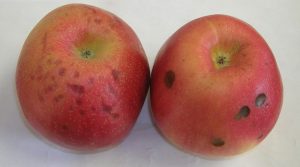
Bitter pit is a disorder that is partly caused past calcium deficiency in apple tree. It begins in the orchard, simply the browning does not develop until after harvest. Small, sunken spots that are light or dark dark-brown and located near the blossom end of the fruit are feature of this disorder. The browning can extend slightly into the flesh. Early harvest, high levels of nitrogen fertility, calorie-free crop load, and large fruit size increase its incidence. Honeycrisp is highly susceptible to biting pit, so early on harvest should be avoided in this variety. Jonagold, Granny Smith, and Cortland are also susceptible, but repeated foliar application of calcium products tin prevent bitter pit in nearly cases. For Honeycrisp, foliar calcium applications should begin at petal fall and continue to harvest.
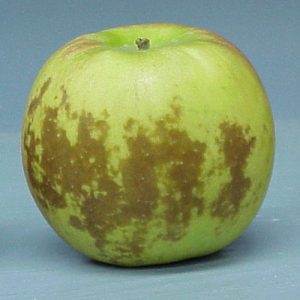
Superficial scald of apple tree is a pare browning disorder that develops in some varieties when they are cold stored longer than 3 months. Brown splotches develop on the green side of the apple, and volition continue to grow in size when the apple is held at warm temperatures. It is besides associated with early harvest date. Cortland, Red Delicious, McIntosh, and Granny Smith are susceptible and should be treated with an anti-scald amanuensis prior to placement in cold or controlled temper storage. Diphenylamine (DPA), one-MCP and ethoxyquin are scald inhibiting agents labeled for use on apple tree. one-MCP is non effective for preventing superficial scald in Cortland, so this variety should receive DPA when stored longer than three months. Gala, Honeycrisp, Golden Delicious, Empire, and SnowSweet are not susceptible to superficial scald.
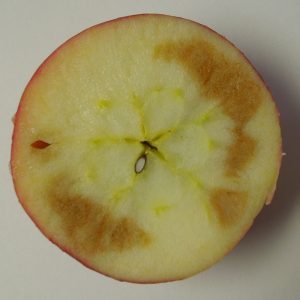
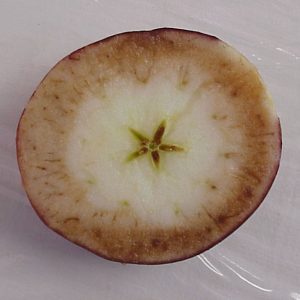
Soggy breakup is an internal chilling injury that develops when susceptible varieties of apple are stored at a temperature beneath their tolerance. For Honeycrisp, temperatures below 37ºF can induce this disorder. Browning develops in the outer cortex. Severity of symptoms range from small brown spots in the cortex to a complete ring of browning around the unabridged apple that ordinarily does not extend to the skin. There is usually ring of unaffected tissue just inside the peel. In Honeycrisp, it often co-occurs with soft scald. Workout the fruit before placement in cold storage does not consistently prevent soggy breakdown and in some cases, tin make information technology more severe. It is recommended that Honeycrisp be stored at temperatures of 37 to 38ºF.
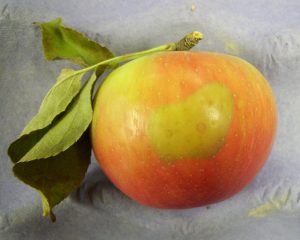 | 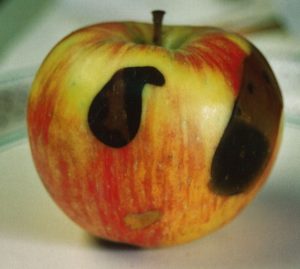 |
Soft scald is a spooky injury disorder that occurs when susceptible varieties of apple are stored at temperatures below their tolerance. Soft scald develops outset every bit a light brown discoloration of the pare. Information technology may extend into the mankind and closely resemble a trample. Eventually, fungal decay volition occur in the affected areas. Severity ranges from minor spots to virtually the entire surface of the apple. Honeycrisp is highly susceptible to this disorder and tin succumb at temperatures normally used for cold storage. Other varieties that can develop soft scald include Golden Delicious and McIntosh, only this rarely occurs at temperatures that are unremarkably used for apple tree storage. Late harvest too worsens symptoms.
Another consequence of tardily harvest is the loss of apples to senescent breakdown, an aging disorder. Some varieties, such as Macoun, develop it after a few months in cold storage whereas other varieties, such equally Cerise Succulent, tin be stored several months without an occurrence. However, all varieties will eventually develop senescent breakdown if stored long enough. Harvest at the right maturity for the storage duration, common cold temperatures, and controlled temper storage are the nigh constructive methods of delaying its occurrence. Application of 1-MCP is also effective in delaying it.
Lenticel breakdown in apple resembles bitter pit but is not isolated to the bloom end of the fruit. Brown circular areas develop over some of the lenticels. Information technology is associated with a late harvest and long storage periods, but the exact cause is unknown. Honeycrisp is prone to this disorder.

Firm flesh browning occurs in Empire and McIntosh apples when stored for long durations at cold temperatures. It occurs more frequently with late harvest and the use of ane-MCP. Light browning occurs in the core and cortex. The flesh is discolored in a full general mode with no distinct purlieus between afflicted and good for you tissue. It is a difficult disorder to forestall since quality loss can occur if storage temperatures are above 35ºF, merely the chance for browning increases at temperatures below this. The most constructive method of prevention is harvesting at an early maturity for apples that volition be stored longer than 4 months.
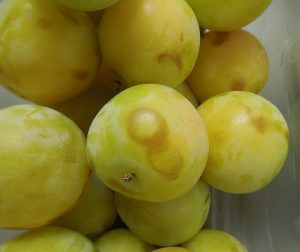
Vibrational bruises can occur in some varieties of plum such as Shiro. Shortly after transporting plums from the orchard, brown circles appear on the peel of sensitive varieties. When transporting plums from the orchard to the packing house or farm marketplace, take steps to reduce movement of fruit in harvest containers.
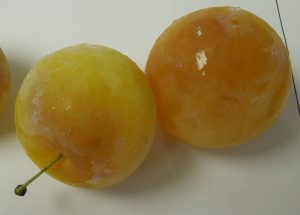
Chilling injury in rock fruit manifests itself in a number of ways. Flesh color can alter from normal to dark-brown and can become translucent. In some cases, the flesh becomes stringy or mealy.
 |  |
Source: https://extension.umaine.edu/fruit/harvest-and-storage-of-tree-fruits/storage-disorders/
0 Response to "Brown Honeycrisp Apple Inside How to Know Before You Buy"
Post a Comment