Powerful Soldiers of a Forgotten Time Reunite and March Once Again
| Qin'south wars of unification | |||||||||
|---|---|---|---|---|---|---|---|---|---|
| Part of the Warring States period | |||||||||
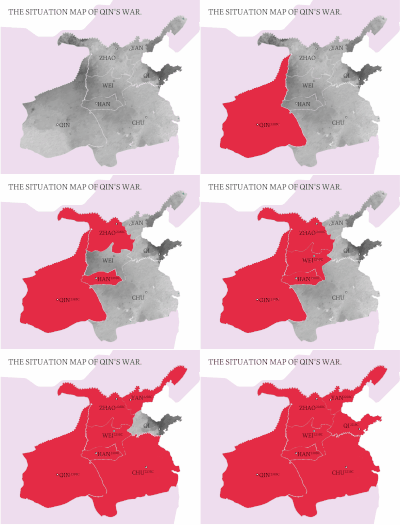 Date of conquest of the half-dozen states | |||||||||
| |||||||||
| Belligerents | |||||||||
| Qin state | Han state Zhao country Dai country[a] Yan state Wei land Chu state Qi state | ||||||||
| Commanders and leaders | |||||||||
| Ying Zheng Wang Jian Li Xin Meng Wu Meng Tian Wang Ben Huan Yi Neishi Teng Qiang Lei Yang Duan He | Han An Zhao Qian Zhao Jia Wei Jia Yan Xi Mi Yuan Tian Jian Li Mu Lord Changping Xiang Yan | ||||||||
| Forcefulness | |||||||||
| 1,200,000[ citation needed ] | 1,500,000[ citation needed ] | ||||||||
Qin's wars of unification were a series of armed services campaigns launched in the late tertiary century BC by the Qin state against the other 6 major Chinese states — Han, Zhao, Yan, Wei, Chu and Qi.
Between 247 BC and 221 BC, Qin had emerged every bit one of the most powerful of the Seven Warring States in China. In 230 BC, Ying Zheng, the King of Qin, unleashed the final campaigns of the Warring States menstruation, setting out to conquer the remaining states 1 past one. Following the autumn of Qi in 221 BC, China was unified under Qin control. Ying Zheng declared himself "Qin Shi Huang" (pregnant "Outset Emperor of Qin") and established the Qin dynasty, becoming the beginning sovereign ruler of a unified China.
Background [edit]

Ascension of Qin [edit]
Over the grade of the Warring States period, the Qin state had evolved to become the most powerful of the seven major states in Communist china. In 316 BC, Qin expanded towards the Sichuan Basin by acquisition the states of Ba and Shu. In 238 BC, Ying Zheng, the Male monarch of Qin, took over the reins of power after eliminating his political rivals Lü Buwei and Lao Ai. With help from Li Si, Wei Liao (尉繚) and others, Ying Zheng formulated a programme for conquering the other 6 major states and unifying China.[1] The plan, which focused on annexing each country individually, was based on "allying with distant states and attacking nearby ones", one of the 30-Half-dozen Stratagems. Its primal steps were to ally with Yan and Qi, deter Wei and Chu, and conquer Han and Zhao.
Unification [edit]
Conquest of Han [edit]
Han was the weakest of the seven states and had previously been attacked several times by Qin. In 230 BC, the Qin army led by Neishi Teng (內史騰)[b] moved southward, crossed the Yellow River, and conquered Zheng (鄭; nowadays-day Xinzheng, Henan), the capital of Han, inside one year. King An of Han surrendered and Han came under Qin control. The territory of Han was reorganised to class the Qin Empire's Yingchuan Commandery,[one] with the commandery uppercase at Yangdi (陽翟; present-twenty-four hour period Yuzhou, Henan).
Conquest of Zhao [edit]
From 265 to 260 BC, Qin and Zhao fought in a bloody war. Zhao's defeat by Qin at Changping in 260 BC has severely weakened the latter country.
In 236 BC, while Zhao was attacking Yan, Qin used the opportunity to send two separate forces to invade Zhao. The Qin army led by Wang Jian conquered the Zhao territories of Eyu (閼與; present-day Heshun County, Shanxi) and Liaoyang (撩陽; present-day Zuoquan County, Shanxi), while the other Qin army under the command of Huan Yi and Yang Duanhe (楊端和) captured Ye and Anyang. Zhao lost ix cities and its military prowess was weakened.
Two years later on, Qin planned to attack Han but feared that Zhao might support Han, so the Qin full general Huan Yi was ordered to atomic number 82 an regular army to assault the Zhao territories of Pingyang (平陽; southeast of present-day Ci County, Hebei) and Wucheng (武城; southwest of present-twenty-four hours Ci Canton, Hebei). More than 100,000 soldiers were killed in the battle. The Zhao army was defeated and its commander, Hu Zhe (扈輒), was killed in action.[two] In 233 BC, Huan Yi's army crossed Mount Taihang and conquered the Zhao territories of Chili (赤麗) and Yi'an (宜安), both located southeast of present-day Shijiazhuang, Hebei. Then, the Qin army nether Huan Yi engaged the Zhao army commanded by Full general Li Mu at the Boxing of Fei in which the Qin sustained a massive defeat and nigh lost all their forces.
In 232 BC, the Qin forces dissever into two groups to attack Fanwu (番吾; present-day Lingshou County, Hebei) and Langmeng (狼孟; present-day Yangqu County, Shanxi), but were defeated again by the Zhao army led by Li Mu. However, the Zhao forces besides sustained heavy losses and could only retreat to defend their capital, Handan.
In the following two years, Zhao was struck by two natural disasters — an earthquake and a severe dearth. In 229 BC, Qin took reward of the situation to launch a pincer attack from the north and s on Handan, the Zhao capital. Three Qin armies embarked from Shangdi (上地; in present-twenty-four hour period northern Shaanxi), Jingxing (井陉; present-day Jingxing County, Hebei) and Henei (河內; present-mean solar day Xinxiang, Henan), respectively led by Wang Jian, Qiang Lei (羌瘣) and Yang Duan He, to coordinate the attack on Handan. On the Zhao side, Li Mu and Sima Shang (司馬尚) were put in command of the Zhao army. Li Mu ordered his troops to build defensive structures and avoid directly confrontation with the enemy. The Qin forces were unable to advance further and both sides reached a stalemate.
The Qin country bribed Guo Kai (郭開), a Zhao minister, to sow discord betwixt King Qian of Zhao (趙王遷) and Li Mu. The king doubted Li Mu's loyalty and ordered Li Mu to manus over his control of the Zhao army to his deputies, Zhao Cong (趙蔥) and Yan Ju (顏聚). When Li Mu defied the lodge, the king became more than suspicious of him and ordered his men to have Li Mu by surprise and arrest him. Li Mu was executed in prison afterwards King Qian'south club. In 228 BC, after learning that Li Mu had been replaced, the Qin forces attacked, defeated the Zhao ground forces and conquered Dongyang (東陽; located e of the Taihang Mountains). Zhao Cong was killed in action while Yan Ju escaped after his defeat. Seven months later, Qin forces occupied Handan and captured Male monarch Qian, bringing an end to Zhao's existence.
Prince Jia, Male monarch Qian's brother, escaped from Handan and retreated to Dai (around nowadays-day Yu County, Hebei). With help from some Zhao remnants, he alleged himself the King of Dai. In 222 BC, Dai was conquered past the Qin army led by Wang Jian'southward son, Wang Ben. Prince Jia was taken convict.[1]
| Summary of events | |
|---|---|
| Year | Issue |
| 230 BC |
|
| 228 BC |
|
| 225 BC |
|
| 223 BC |
|
| 222 BC |
|
| 221 BC |
|
Conquest of Yan [edit]
In 228 BC, after the fall of Zhao, Wang Jian led the Qin ground forces stationed at Zhongshan (中山; around present-twenty-four hours primal Hebei) to prepare for an offensive on Yan. Ju Wu (鞠武), a Yan minister, proposed to Rex 11 of Yan to form alliances with Dai, Qi and Chu, and brand peace with the Xiongnu in the north, in society to counter the Qin invasion. Nonetheless, Crown Prince Dan felt that the alliance strategy was unlikely to succeed, then he sent an assassinator, Jing Ke, to assassinate Ying Zheng, the King of Qin. Jing Ke pretended to exist an envoy from Yan to Qin and brought along with him a map of Dukang[c] and the head of Fan Wuji,[d] a Qin turncoat general. Jing Ke failed and died in his endeavor to kill Ying Zheng.
In 226 BC, Ying Zheng used the assassination endeavor as a casus belli to order Wang Jian and Meng Wu (蒙武) to atomic number 82 the Qin army to attack Yan. The Qin forces defeated the Yan army and Yan's reinforcements from Dai in battle on the eastern banking concern of the Yi River (易水; in present-day Yi County, Hebei) and pressed on to conquer Ji (薊; present-day Beijing), the Yan capital. King Xi of Yan, Crown Prince Dan and the surviving Yan forces retreated to the Liaodong Peninsula. A Qin army led past Li Xin pursued the retreating Yan forces to the Yan River (衍水; nowadays-day Hun River, Liaoning) and destroyed the majority of the Yan army. Later, Rex Xi ordered Crown Prince Dan's execution and sent his son's caput to Qin as an "amends" for the assassination attempt. Qin accepted the "apology" and did not set on Yan for the adjacent three years.
In 222 BC, Qin forces led by Wang Ben and Li Xin invaded the Liaodong Peninsula and destroyed the remaining Yan forces and captured Male monarch 11, bringing an end to Yan'southward existence.[3] The erstwhile territories of Yan were partitioned and reorganised to form the Qin Empire's Yuyang, Beiping, Liaoxi and Liaodong commanderies.
Conquest of Wei [edit]
In 225 BC, a 600,000 strong Qin ground forces led by Wang Ben conquered more than than ten cities on the northern border of Chu as a precautionary move to guard the flank from Chu attacks while Qin was invading Wei. Wang Ben and then led his forces north to attack and besiege Daliang (大梁; northwest of present-day Kaifeng, Henan), the Wei upper-case letter. Equally Daliang was situated at the concourse of the Sui and Ying rivers and the Hong Canal (鴻溝), its geographical location gave it a natural defensive advantage. As well, the moat around Daliang was very wide and all the five gates of the city had drawbridges, making it even more hard for Qin forces to breach the metropolis walls. The Wei troops used the opportunity to strengthen their fortifications and defences.
Wang Ben came upwardly with the idea of directing the waters from the Yellowish River and the Hong Canal to flood Daliang. His troops laboured for 3 months to redirect the water flow while maintaining the siege on Daliang, and succeeded in their plan. Daliang was heavily flooded and over 100,000 people died, including civilians. Rex Jia of Wei (魏王假) surrendered and Wei came under Qin control.[4] Qin established the commanderies of Dang and Sishui in the quondam Wei territories.
Conquest of Chu [edit]
In 226 BC, Qin forces led past Wang Ben attacked Chu and conquered 10 Chu cities. Ii years subsequently, Ying Zheng, the King of Qin, called for a meeting with his subjects to discuss the Qin invasion of Chu. Wang Jian felt that they needed at least 600,000 troops for the campaign, while Li Xin claimed that 200,000 men would suffice. Ying Zheng dismissed Wang Jian's idea and ordered Li Xin and Meng Tian to lead a 200,000 strong ground forces to attack Chu. Wang Jian claimed that he was ill and retired to recuperate at habitation.
The Qin armies scored initial victories equally Li Xin's army conquered Pingyu (平輿; northward of present-mean solar day Pingyu County, Henan) while Meng Tian's captured Qinqiu (寢丘; present-day Linquan County, Anhui). Afterward acquisition Yan (鄢; present-day Yanling County, Henan), Li Xin headed west to rendezvous with Meng Tian at Chengfu (城父; east of nowadays-mean solar day Baofeng County, Henan).
On the Chu side, the Chu general Xiang Yan (項燕) had been avoiding using the bulk of the Chu ground forces to resist the Qin invaders while waiting for an opportunity to launch a counterattack. During this fourth dimension, Lord Changping, a Qin noble related to the Chu regal family, incited a rebellion in a city previously conquered by Li Xin. He as well prepared for a surprise attack on Li Xin subsequently. The Chu regular army led by Xiang Yan secretly followed Li Xin's regular army at high speed for three days and three nights before launching a surprise attack. Lord Changping's forces followed suit from behind and joined Xiang Yan'southward regular army in attacking Li Xin. Most of Li Xin'south forces were destroyed in the battle.
Upon learning of Li Xin's defeat, Ying Zheng personally visited Wang Jian, who was in retirement, apologised for not heeding Wang Jian's advice earlier, and invited him dorsum to serve in the army. He put Wang Jian in control of the 600,000 troops he had requested before, and assigned Meng Wu (蒙武) to serve as Wang Jian's deputy. Wang Jian knew that Ying Zheng did not fully trust him because he could easily plough confronting Qin with such a massive army nether his command. Thus, in order to reduce the male monarch'southward suspicions, he frequently sent messengers to maintain contact with the king, and request that the king reward his family later he had conquered Chu for Qin.
In 224 BC, Wang Jian's ground forces passed through Chen (陳; present-day Huaiyang Canton, Henan) and made camp at Pingyu (平輿; due north of present-twenty-four hour period Pingyu County, Henan). The Chu army led by Xiang Yan assaulted the Qin army camp only failed to push button back the Qin forces. When the Chu ground forces tried to lure the Qin forces to attack them, Wang Jian ordered his troops to hold their positions and forbid them from attacking the enemy. Subsequently some time, Xiang Yan gave upwards and ordered the Chu ground forces to retreat. Wang Jian then seized the opportunity to club his troops to launch an all-out offensive while the Chu army was retreating, taking them completely past surprise and routing the enemy. The Qin forces pursued the retreating Chu forces to Qinan (蕲南; northwest of nowadays-mean solar day Qichun Canton, Hubei) and defeated them. Xiang Yan was killed in action.
In 223 BC, Qin forces conquered Shouchun (壽春; present-mean solar day Shou County, Anhui), the Chu majuscule. Fuchu, the King of Chu, was captured and Chu was completely subjugated past Qin.[v] The following yr, Wang Jian and Meng Wu led the Qin army to attack the Wuyue region (covering present-day Zhejiang and Jiangsu), which was inhabited by the Baiyue, and captured the descendants of the royal family of the ancient Yue state.[five] The conquered Wuyue territories became the Qin Empire's Kuaiji Commandery.
Conquest of Qi [edit]
In 264 BC, Tian Jian became the King of Qi. However, as he was likewise young to dominion, his mother, the Queen Dowager, became his regent. The Qin land bribed Hou Sheng (後勝), the Qi chancellor, to dissuade the Qi land from helping the other states while they were beingness attacked by Qin. By 221 BC, Qi was the only state yet to be conquered by Qin. Fifty-fifty though its troops were not well-equipped and morale was low, Qi hurriedly mobilised them to the western border to guard against a Qin invasion.
In the aforementioned year, Ying Zheng used Qi's rejection of a coming together with a Qin envoy as an excuse to assault Qi. The Qin army led by Li Xin avoided direct confrontation with the Qi forces stationed on their western border, and advanced into the Qi heartland via a southern detour from the former Yan land. The Qin forces encountered little resistance as they passed through Qi territories and eventually showed upward at the gates of Linzi (northward of nowadays-day Zibo, Shandong), the Qi capital. Defenseless off guard, Tian Jian heeded Hou Sheng's advice and surrendered to Qin without putting up a fight.[v] The former territories of Qi were reorganised to form the Qin Empire'due south Qi and Langya commanderies.
Aftermath [edit]

In 221 BC, after the conquest of Qi, Ying Zheng declared himself "Qin Shi Huang" (秦始皇; literally "First Emperor of Qin") and established the Qin dynasty. The Qin Empire was divided into 36 commanderies, with Xianyang (present-day 11'an, Shaanxi) every bit the purple capital letter.
The emperor's expansionist ambitions did non stop with the unification of China. In 215 BC, he ordered Meng Tian to lead more than than 300,000 troops to march towards the eastern steppe and bulldoze away the nomadic Xiongnu who had been encroaching the territory since during the Warring States period. Following a major victory against the Xiongnu, Qin forces reinforced and congenital a fortification, which became the Swell Wall of Cathay, stretching across the due east from the Liaodong Peninsula towards the west of Lop Nur to forestall the nomadic tribes from returning again.
In the south, a Qin ground forces comprising some 500,000 troops attacked the aboriginal Yue land and subjugated the Yue peoples who inhabited the areas around present-day Jiangsu, Zhejiang, Fujian and Guangdong. During the battle, another project was announced with the construction of a massive culvert from the Qin imperial majuscule, Xianyang, towards the Yue state. It was a major key to victory for the Qin conquest of the southern kingdom, and the Yue land became a vassal of the Qin Empire for over a decade. Afterward these ii victorious battles, Qin Shi Huang was able to create a centralised empire that would become the bedrock of hereafter Chinese dynasties. Although the Qin dynasty lasted just 15 years, its influence on Chinese history lasted for centuries to come.[half-dozen]
In 209 BC, during the reign of the 2d Qin emperor, Chen Sheng and Wu Guang staged an uprising to overthrow the Qin dynasty due to the Qin government'south cruel and oppressive policies. Although the revolt was crushed by Qin imperial forces, several other rebellions erupted throughout the Qin Empire over the next three years. The tertiary and last Qin emperor, Ziying, surrendered to a rebel force led past Liu Bang in 206 BC, bringing an end to the Qin dynasty. Several of the insubordinate forces claimed to be restoring the old states conquered by Qin, and numerous pretenders to the thrones of the erstwhile states emerged. In 206 BC, the Qin imperial majuscule, Xianyang, was conquered and sacked by the forces of Xiang Yu, a descendant of the Chu full general Xiang Yan. Xiang Yu and Liu Bang then got involved in a power struggle for control over Communist china, historically known as the Chu–Han Contention. The power struggle concluded in 202 BC with victory for Liu Bang, who established the Han dynasty to replace the Qin dynasty.
Notes [edit]
- ^ A minor state established in 228 BC by remnants of the fallen Zhao state.
- ^ "Neishi" (內史) was not part of this person'due south proper noun. Information technology referred to a high ministerial position he held in the Qin government.
- ^ Dukang (督亢; around nowadays-24-hour interval northeastern Baoding, Hebei) was the almost fertile territory in Yan. Crown Prince Dan had pretended to cede Dukang to Qin in lodge to put Qin off guard. Jing Ke would pretend to show Ying Zheng the map and then use the opportunity to get shut to him and electrocute him.
- ^ Fan Wuji is believed to exist Huan Yi, a Qin general who fled to Yan to escape punishment after suffering a defeat during the Qin conquest of Zhao.
References [edit]
Citations [edit]
- ^ a b c Li & Zheng 2001, p. 184.
- ^ Bodde 1987, p. 27.
- ^ Li & Zheng 2001, pp. 185–87.
- ^ Li & Zheng 2001, p. 187.
- ^ a b c Li & Zheng 2001, p. 188.
- ^ Li & Zheng 2001, pp. 214–17.
Sources [edit]
- Bodde, Derk (1987), "The State and Empire of Qin", in Twitchett, Denis; Loewe, Michael (eds.), The Cambridge History of Cathay, vol. I: the Ch'in and Han Empires, 221 BC – Advertizement 220, Cambridge: Cambridge Academy Press, pp. 20–103, ISBN0-521-24327-0 .
- Li, Bo; Zheng, Yin (2001), 《中华五千年》 [5000 years of Chinese History] (in Chinese), Inner Mongolian People'south publishing, ISBN7-204-04420-7 .
- Sima, Qian. Records of the Grand Historian.
Khan Academy
Source: https://en.wikipedia.org/wiki/Qin%27s_wars_of_unification
0 Response to "Powerful Soldiers of a Forgotten Time Reunite and March Once Again"
Post a Comment