Read File One Line at a Time With a for Loop
What is Python readline?
Python readline() is a file method that helps to read one complete line from the given file. It has a trailing newline ("\n") at the end of the string returned.
Yous can also make use of the size parameter to get a specific length of the line. The size parameter is optional, and by default, the entire line will be returned.
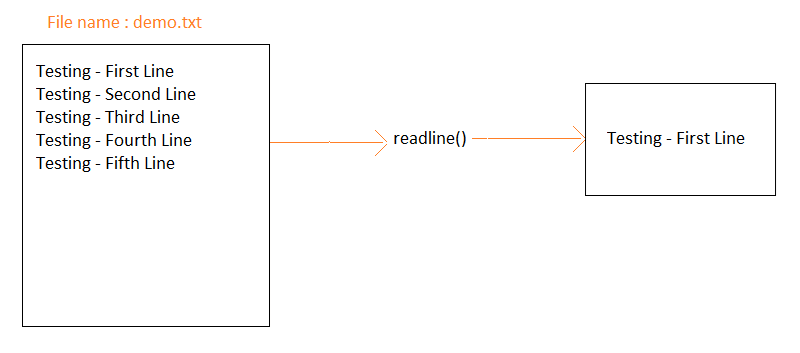
The flow of readline() is well understood in the screenshot shown beneath:
You have a file demo.txt, and when readline() is used, information technology returns the very kickoff line from demo.txt.
In this tutorial, yous volition learn:
- Python File readline
- Characteristic of Python readline()
- Syntax
- Example: To read the first line using readline()
- Example: Using size argument in readline()
- Basic File IO in Python
- Read a File Line-by-Line in Python
- How to read all lines in a file at once?
- How to read a File line-by-line using for loop?
- How to read a File line-by-line using a while loop?
Characteristic of Python readline()
Here, are important characteristics of Python read line:
- Python readline() method reads merely one consummate line from the file given.
- It appends a newline ("\n") at the stop of the line.
- If you open the file in normal read mode, readline() will return y'all the string.
- If you open the file in binary manner, readline() will return you binary object.
- Y'all tin give size as an argument to readline(), and it volition become you the line as per the size given inclusive of the newline. By default, the size is 0, and it returns the entire line.
Syntax
file.readline(size)
Parameters
size: (optional) Hither, you can specify the number, an integer value to readline(). It will get the string of that size. By default, the value of size is -1, and hence the entire string is returned.
ReturnValue
The readline() method returns the line from the file given.
Example: To read the first line using readline()
Here will empathise how to read the line from the file given using the readline() method. We are going to brand use of demo.txt file here to read the contents.
The file contents of demo.txt are as follows:
demo.txt
Testing - FirstLine Testing - SecondLine Testing - Third Line Testing - 4th Line Testing - Fifth Line
The following are the steps to read a line from the file demo.txt.
Step 1)
Commencement, open the file using the file open up() method, as shown below:
myfile = open("demo.txt", "r") The open() method takes the first parameter as the name of the file, and the 2d parameter is the style is while you want to open. Right now, nosotros have used "r", which ways the file will open in read fashion.
Step 2)
Utilise the readline() method to read the line from the file demo.txt as shown beneath:
myline = myfile.readline()
Step three)
The line read is stored inside myline. Permit us now impress the line to see the details:
print(myline)
Step four)
In one case the reading is done, close the file using close() method as shown beneath:
myfile.close()
The entire code is as follows:
myfile = open("demo.txt", "r") myline = myfile.readline() print(myline) myfile.close() Output:
Testing - FirstLine
Example: Using size argument in readline()
We accept seen how to read the entire line from the file given. You can also make use of the size parameter to become merely the required length of the line.
The given case has the size parameter given as 10. The first line will be fetched, and it will return the line with characters from 0 to 10.
We are going to make use of demo.txt file used before. Save the file demo.txt and apply the location of the demo.txt inside open() function.
myfile = open("demo.txt", "r") myline = myfile.readline(10) print(myline) myfile.shut() Output:
Testing -
Basic File IO in Python
The basic file IO in Python to open a file for reading or writing is the built-in open() function. The two important arguments that goes in open up() function are the file path, which is a cord, and the mode that specifies whether the file is meant for reading or writing. The mode statement is a string.
Syntax:
open up("file path", "style") Following are the modes bachelor that can be used with open up() method:
| Fashion | Clarification |
|---|---|
| R | This will open() the file in read mode. |
| W | Using w, you can write to the file. |
| a | Using a with open() will open the file in write manner, and the contents will be appended at the end. |
| rb | The rb manner will open up the file for binary data reading. |
| wb | The wb mode will open the file for writing binary information. |
Since nosotros need the file for reading, nosotros are going to make use of read mode i.e. (r).
Read a File Line-by-Line in Python
The readline() method helps to read but one line at a time, and it returns the kickoff line from the file given.
Hither, we will brand utilise of readline() to read all the lines from the file given. The file that will read is demo.txt. The contents of the file are:
Salve the file demo.txt and utilize the location of demo.txt inside open() office.
Testing - FirstLine Testing - SecondLine Testing - 3rd Line Testing - 4th Line Testing - Fifth Line
Using readline() inside while-loop will take care of reading all the lines present in the file demo.txt.
myfile = open("demo.txt", "r") myline = myfile.readline() while myline: print(myline) myline = myfile.readline() myfile.close() Output:
Testing - FirstLine Testing - SecondLine Testing - 3rd Line Testing - Fourth Line Testing - Fifth Line
How to read all lines in a file at once?
To read all the lines from a given file, yous can make apply of Python readlines() part. The specialty of Python readlines() function is to read all the contents from the given file and salvage the output in a list.
The readlines() office reads until the End of the file, making use of readline() part internally and returns a listing with all the lines read from the file.
Here is a working instance to read all the lines from the file using readlines().
The file that we are going to make utilise of to read is examination.txt. The contents of the file test.txt are every bit follows:
test.txt: Save the file examination.txt and use the location of test.txt inside open up() part.
Line No 1 Line No 2 Line No 3 Line No 4 Line No 5
myfile = open("exam.txt", "r") mylist = myfile.readlines() print(mylist) myfile.close() Output:
['Line No 1\n', 'Line No 2\n', 'Line No 3\n', 'Line No 4\n', 'Line No 5']
How to read a File line-by-line using for loop?
Post-obit are the steps to read a line-by-line from a given file using for-loop:
Step1 :
Start, open the file using Python open() function in read mode.
Step 2:
The open() function will return a file handler. Use the file handler inside your for-loop and read all the lines from the given file line-past-line.
Footstep three:
Once done, close the file handler using the close() office.
Here is a working instance of using for-loop to read line-past-line from a given file. The file that we are going to use here is test.txt.
The contents of exam.txt are as shown beneath. Salve the file test.txt and use the location of test.txt inside an open up() function.
Line No ane Line No 2 Line No 3 Line No iv Line No v
myfile = open up("test.txt", "r") for line in myfile: print(line) myfile.close() Output:
Line No ane Line No two Line No three Line No 4 Line No 5
How to read a File line-past-line using a while loop?
You tin make use of a while loop and read the contents from the given file line-by-line. To do that, first, open the file in read mode using open() part. The file handler returned from open up(), employ information technology inside while –loop to read the lines.
Python readline() role is used inside while-loop to read the lines. In the instance of for-loop, the loop terminates when the end of the file is encountered. Merely the same is non the example with a while-loop, and you lot need to keep a check to see if the file is done reading. So one time the readline() role returns an empty string, you can make utilize of the break statement to terminate from the while –loop.
Hither is a working example to read a file line by line using a while-loop.
The file that we are going to make use is test.txt .Salve the file test.txt and use the location of test.txt inside open up() part.
Line No 1 Line No 2 Line No 3 Line No iv Line No v
myfile = open up("test.txt", "r") while myfile: line = myfile.readline() print(line) if line == "": break myfile.close() Output:
Line No i Line No 2 Line No 3 Line No 4 Line No v
Summary
- Python readline() is a file method that helps to read one complete line from the given file. It has a abaft newline ("\n") at the terminate of the string returned.
- You can also brand use of the size parameter to get a specific length of the line. The size parameter is optional, and by default, the entire line will be returned.
- The readline() method helps to read simply ane line at a fourth dimension, and information technology returns the starting time line from the file given. Nosotros will make utilise of readline() to read all the lines from the file given.
- To read all the lines from a given file, you tin can brand use of Python readlines() office. The specialty of Python readlines() function is that it reads all the contents from the given file and saves the output in a list.
- The readlines() function reads till the End of the file making use of readline() function internally and returns a list that has all the lines read from the file.
- It is possible to read a file line by line using for loop. To do that, kickoff, open up the file using Python open up() function in read fashion. The open() function volition return a file handler. Utilize the file handler inside your for-loop and read all the lines from the given file line by line. Once done,close the file handler using shut() function.
- You can make utilise of a while loop and read the contents from the given file line by line. To practise that, first, open the file in read mode using open up() function. The file handler returned from open(), use it within while –loop to read the lines. Python readline() function is used inside while-loop to read the lines.
Source: https://www.guru99.com/python-file-readline.html
0 Response to "Read File One Line at a Time With a for Loop"
Post a Comment