Art of Person Floating in a Lake Then the Lake Becomes Space
/https://tf-cmsv2-smithsonianmag-media.s3.amazonaws.com/filer/d9/51/d951902d-789a-4fba-82b7-8f7f3368ebb1/jun2016_h02_colchristo.jpg)

Christo Invites Public to Walk on H2o
—headline,The Art Newspaper, April 2015
"I thought,'I'one thousand going to be 80 years sometime. I'd like to exercise something very hard.'"
—Christo
**********
The lake is impossible.
The lake is a painting of a lake; the water a painting of water. Like floating on a 2d sky. Too bluish. Likewise cool. Too deep. Impossible. The mountains, too. Too steep, too green with trees, too white with snow. Villages pour downward the hills and run russet and ocher and brown to the water's edge. Blood-red tile rooftops necklace the shore. Flat at-home, and at midday the quiet carries from one stop of Lago d'Iseo to the other, from the vineyards to the mines to the minor hotels. The stillness hither has weight. He raises his vocalism.
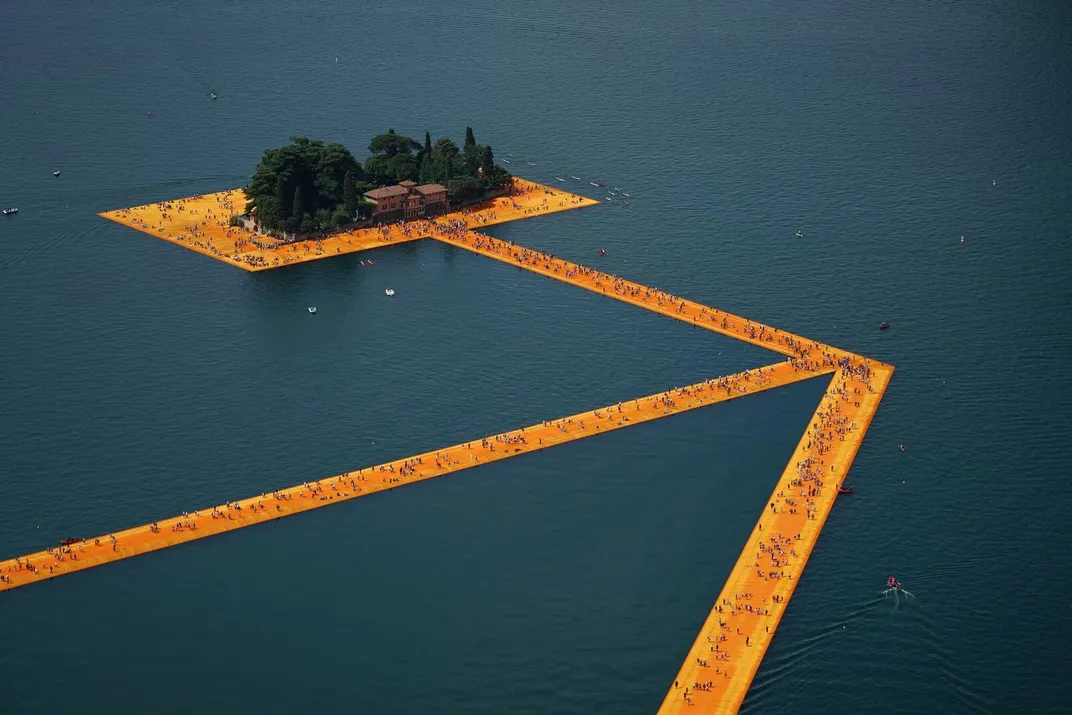
"Floating Piers will be three kilometers long. And will use 220,000 polyethylene cubes. Fifty centimeters by 50 centimeters. Two hundred twenty thousand screws. Interlocking."
KiloMAYters. CentiMAYters. His English language is skilful, but the Bulgarian emphasis is thick. Even at present, then many years later. He tilts his chin up to exist heard.
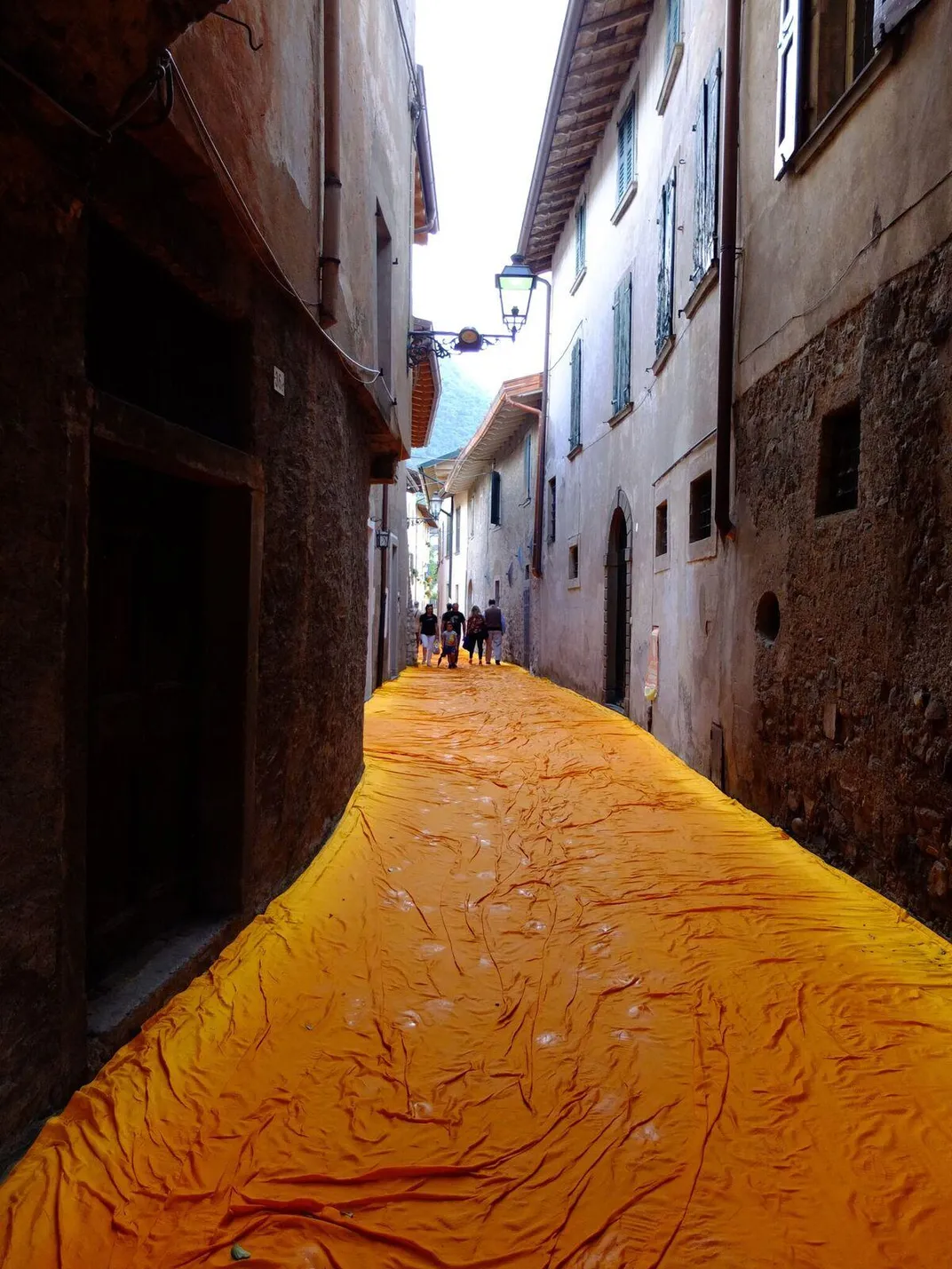
"Ninety thousand foursquare meters of fabric."
MAYters.
"Non just on the Piers, just in the streets too."
The hair is a white halo beneath a crimson difficult lid and above the red anorak. Dress shirt and jeans. Oversized brown boots. He is slender, big-eared and fine-boned, with long, expressive hands. Not tall simply straight, unbent fifty-fifty at 80. He radiates energy and purpose.
**********
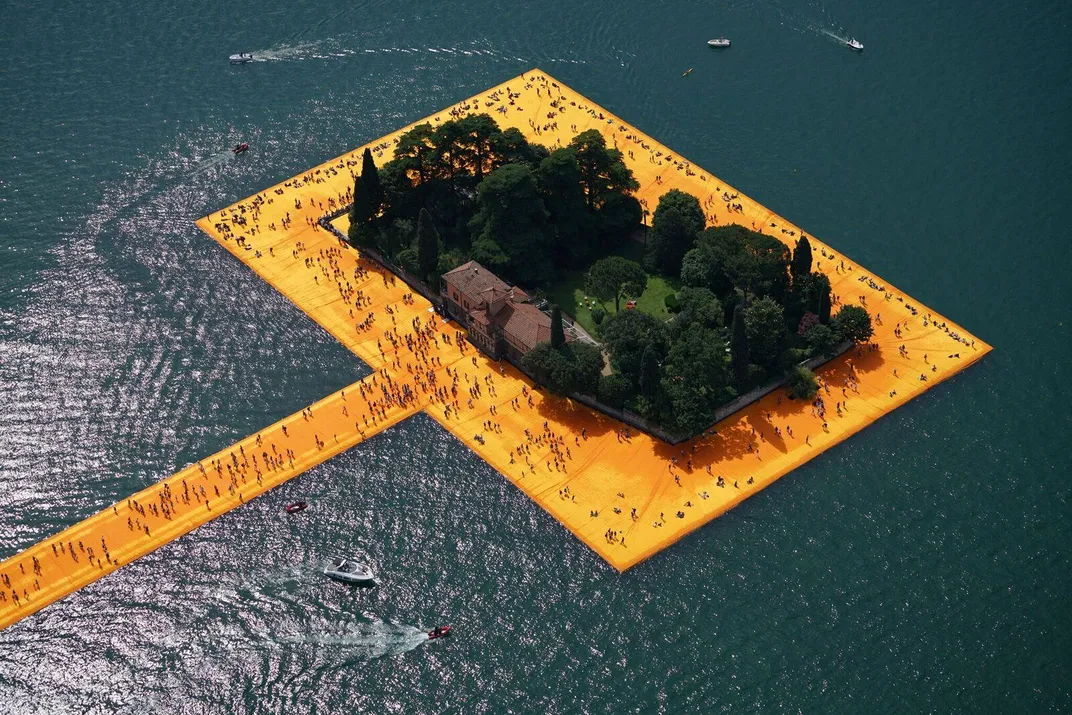
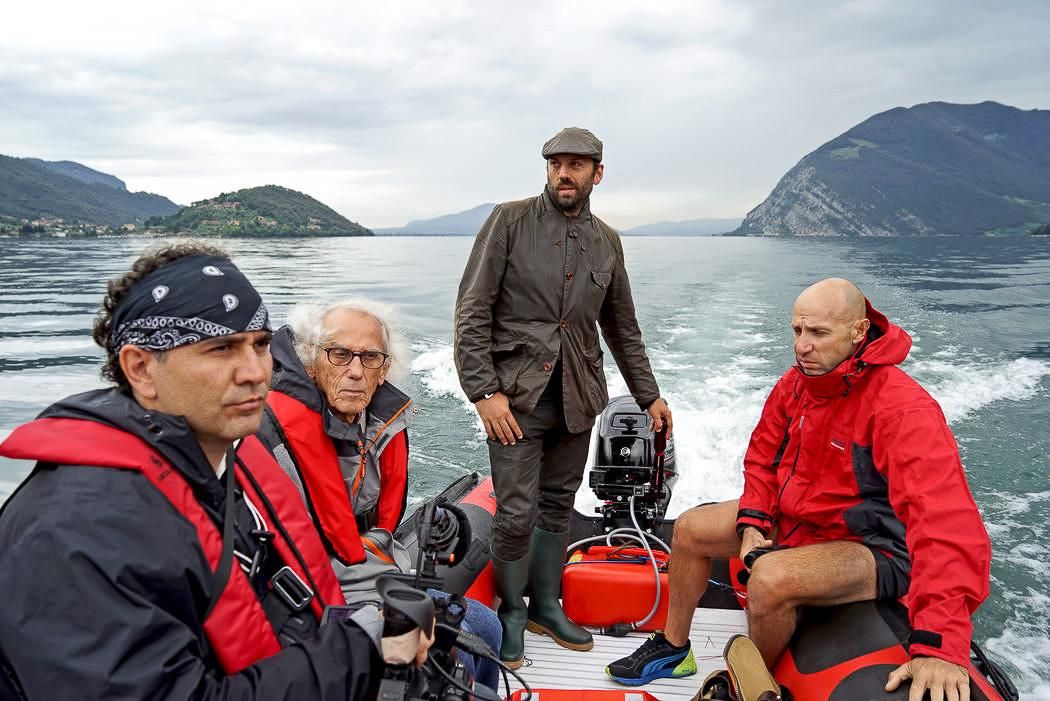
"From Sulzano to Monte Isola and out to Isola di San Paolo," he says, pointing. "Each pier built in sections 100 meters long. Then joined." Backside the glasses the eyes are dark, lively, tired. He smiles. This, the talking, is part of the art, too. "Sixteen meters broad, and slope into the water along the sides," he gestures a shallow angle with his correct hand, "like a embankment." Two dozen members of the Italian press and ii dozen local politicians nod and stand and whisper.
"One hundred lx anchors. Each anchor weighs five tons," Christo says.
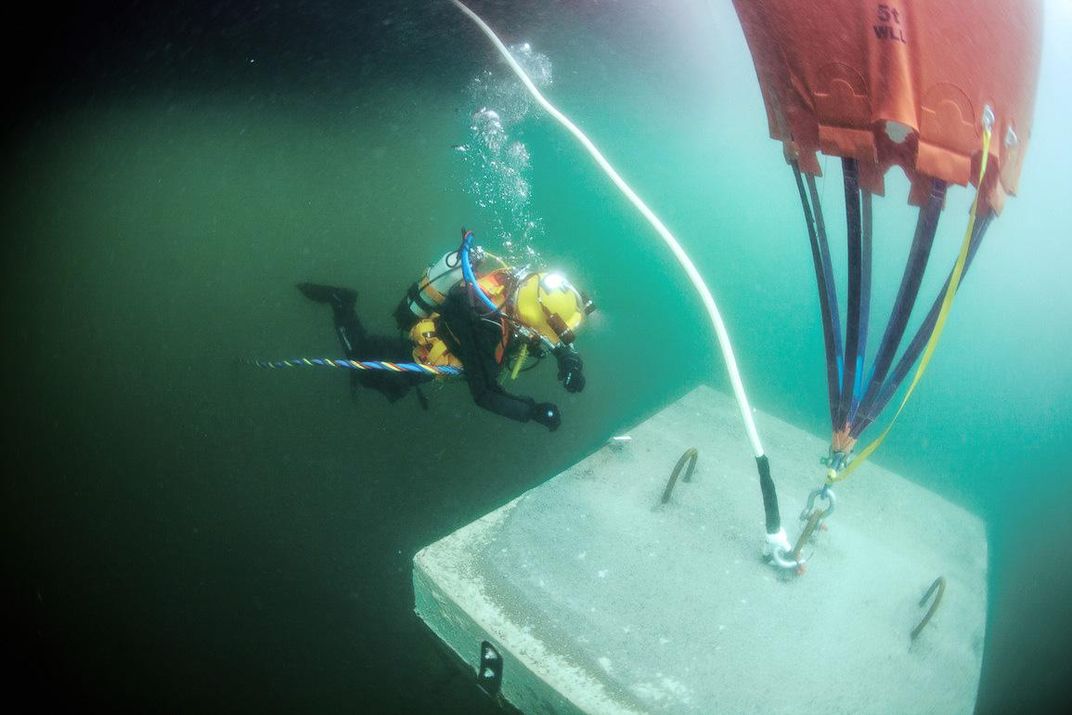
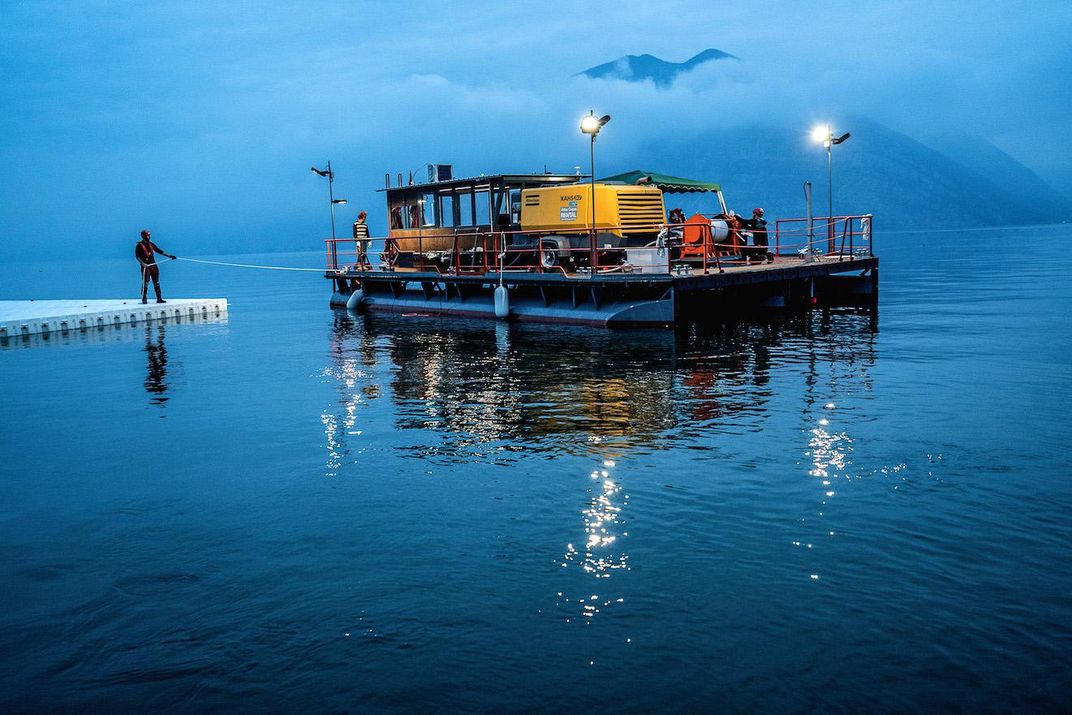
He's standing just aft of the deckhouse on the boat the defined utilize to sink those anchors. The boat is a long platform on long hulls. Similar him, the gunkhole and the defined are from Republic of bulgaria. The divers have been out here nearly of the winter, working in the dark and the cold and the unimaginable silence of the deep lake. "One hundred meters depth," says Christo. The boat is a few hundred yards offshore, near the floating corral where finished sections of pier are tied up. Waiting.
He moves from group to group —anybody gets a annotate, everyone gets a quote, a photo—surrounded by reporters and local mayors.
"Thirty-v boats. Thirty Zodiacs. Thirty brand-new motors."
Cameras. Microphones. Notebooks.
"Sixteen days. Hundreds of workers."
The smile widens.
"This fine art is why I don't accept commissions. It is absolutely irrational."
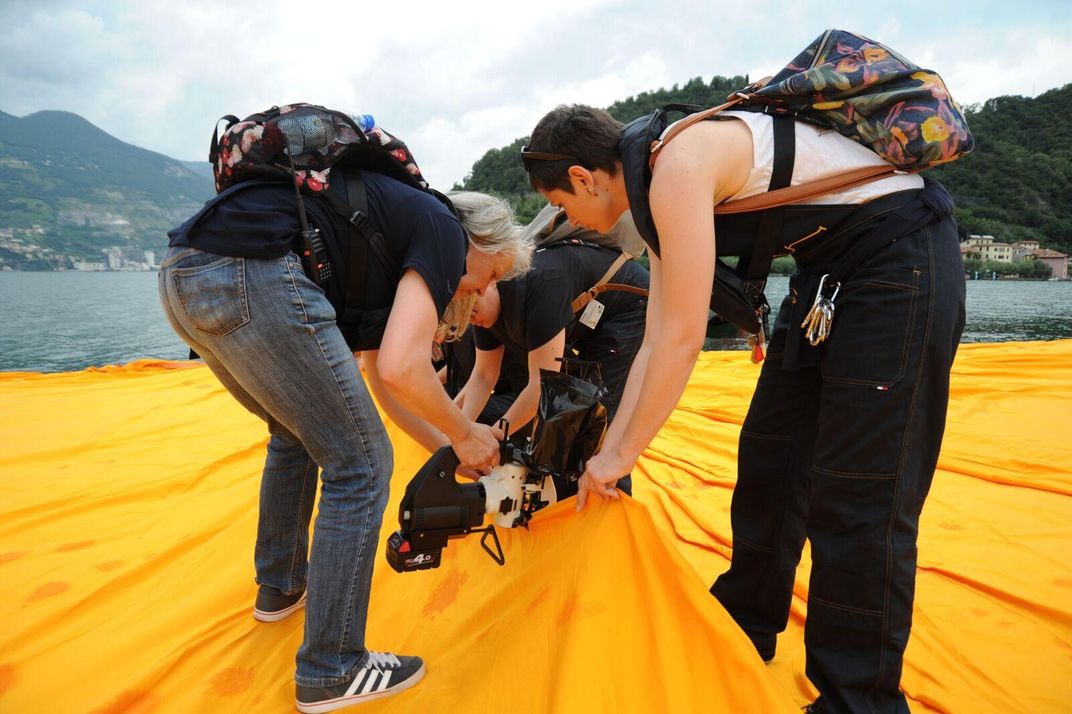
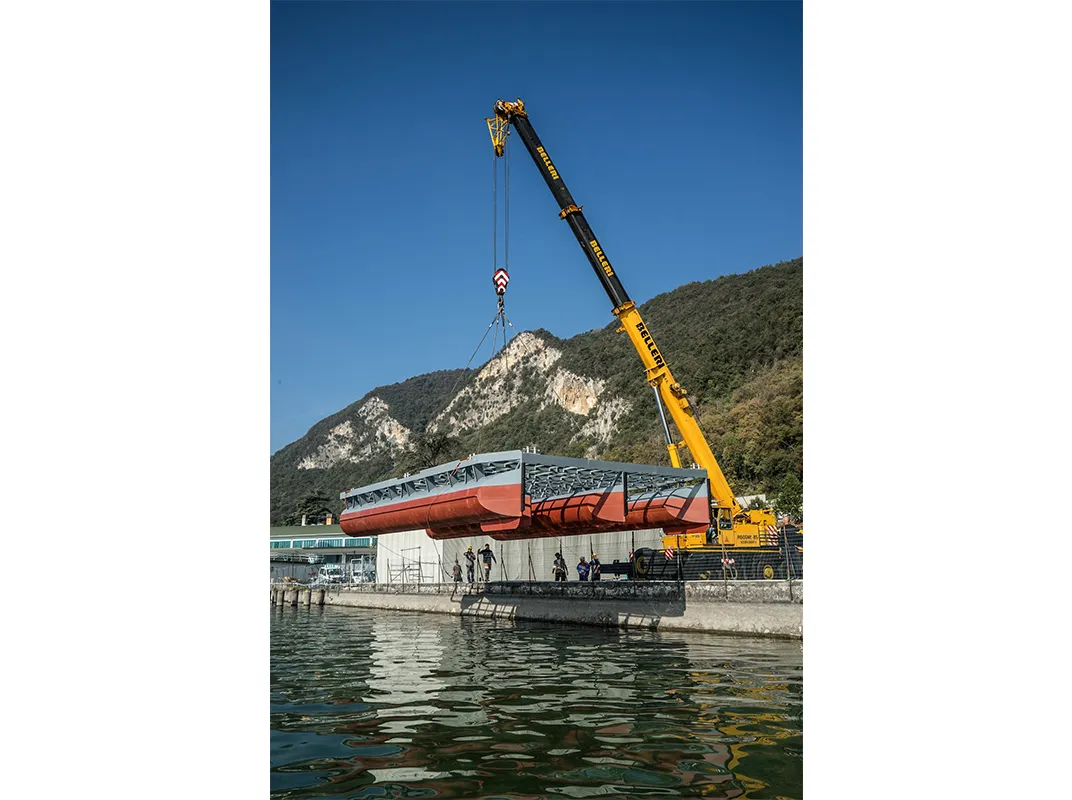
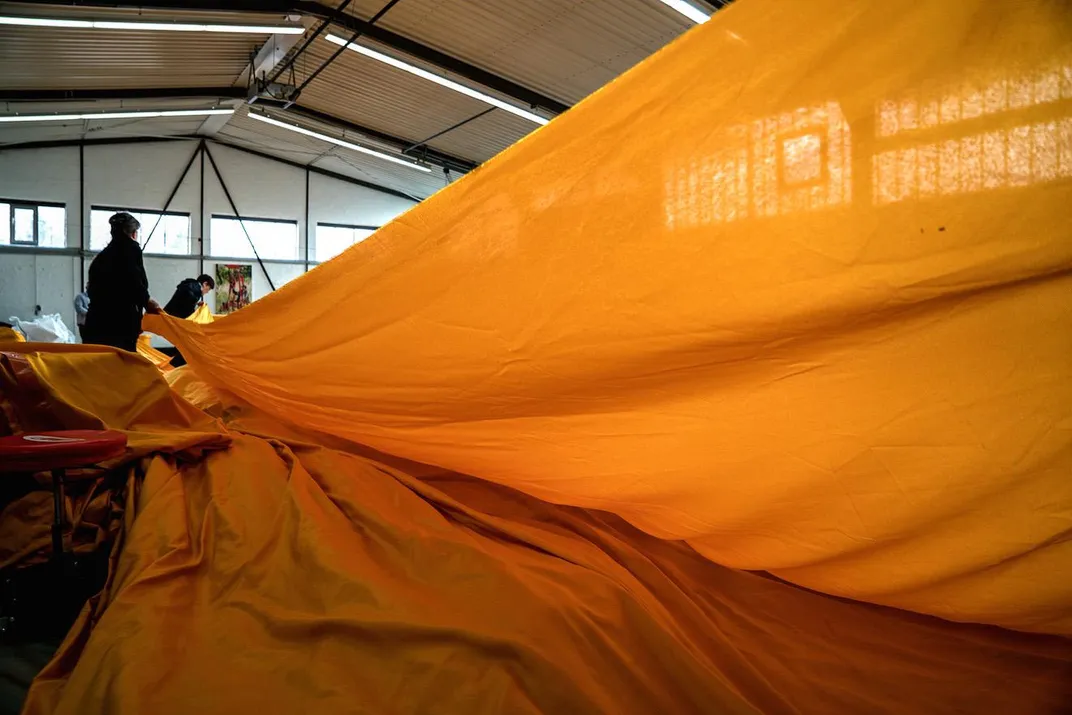
In the construction shed onshore, however more than Bulgarians are back from lunch. Two teams screw together theFloating Piers block by block past block, eight hours a day, seven days a week. It volition take months. You can hear the sound of the big impact wrench for miles in the quiet.
**********
2 weeks at a fourth dimension, he is the almost famous artist on earth.
Christo. Terminal proper noun Javacheff. Born June xiii, 1935, in Bulgaria. Studies art. Flees the Soviet advance across the Eastern bloc at 21, arrives in Paris spring, 1958. Meets his future married woman and collaborator that year while painting her mother's portrait. The first wave of fame comes when they block the rue Visconti in Paris with stacked oil drums. A sculptural commentary on the Berlin Wall and oil and Algeria and culture and politics. That was 1962.
"At a very early moment in postwar fine art, they expanded our agreement of what art could exist," says art historian Molly Donovan, an associate curator at the National Gallery of Art in Washington, D.C. "Crossing the boundary out of the gallery and the museum—by putting works in the public sphere, in the congenital environs—that was really groundbreaking in the early on '60s."
Then small wraps and faux storefronts and draped fabrics and wrapped fountains and towers and galleries. Then ten,000 square feet of cloth wrapping the Museum of Contemporary Art in Chicago. Then in 1969 a meg square feet of fabric draped and tied over the rocks outside Sydney and they are all of a sudden/not suddenly world famous. "The concept of art was so narrow at the time," recalled Australian artist Imants Tillers, "thatWrapped Coast appeared to be the work of a madman." Filmmakers start following them. Journalists. Critics. Fans. Detractors. And then the debate over what information technology is. Conceptual art? Land art? Performance art? Environmental art? Modernist? Post-Minimalist?
As critic Paul Goldberger has said, information technology is "at once a piece of work of fine art, a cultural outcome, a political happening and an ambitious piece of business."
Valley Curtain, Colorado, 1972. Ii hundred thousand, two hundred foursquare feet of fabric drawn across the canyon at Rifle Gap.Running Fence, California, 1976. A wall of cloth 18 feet high running 24.5 miles through the hills north of San Francisco into the bounding main; now in the collections of the Smithsonian Institution.Surrounded Islands, Miami, 1983. Eleven islands in Biscayne Bay surrounded past half-dozen.5 million square feet of vivid pinkish fabric.The Pont Neuf Wrapped, Paris, 1985. The oldest bridge in the city wrapped in 450,000 foursquare anxiety of textile, tied with eight miles of rope.The Umbrellas, Japan and California, 1991. Iii k one hundred umbrellas, 20 anxiety loftier, 28 feet wide; blue in Ibaraki Prefecture, yellow along the I-5 northward of Los Angeles. Cost? $26 million. Two accidental deaths.Wrapped Reichstag, Berlin, 1995. One meg square feet of silver fabric; virtually ten miles of bluish rope; five million visitors in two weeks.The Gates, New York City, 2005.
"They cantankerous boundaries in our imagination nearly what's possible," Donovan says. "People like the sense of joyousness that they celebrate, the joy in the work. The work isn't whimsical, necessarily. They're serious works. The openness and exuberant colors—people respond to that."
"Their projects continue to piece of work on your mind," she says. "Why do they experience so powerful or meaningful? On the global calibration, they've elicited a lot of thought about what fine art can exist, where it can be, what it can look similar. They've really broadened the locations for where art can happen."
Then in 2005 when 7,503 gates open along 23 miles of paths in Fundamental Park, alluring more than four million visitors, columnist Robert Fulford wrote in Canada'sNational Post, "The Gates came and went quickly, similar an eclipse of the dominicus. In their evanescence they recalled the Japanese cult of the blood-red blossom, which blooms briefly each leap and in Japanese poetry symbolizes the brevity of life."
"I think the really amazing thing about Christo, the reason why he has plant the sweet spot betwixt the art globe and the world at large—and is such a pop public effigy," Michael Kimmelman of theNew York Times says, "is because he realized that if he took art, if he used the political process and public space every bit the place in which to make art, and to bring the public into the process itself, that he would redefine both the audience for this art and too redefine what had been called public art before."
**********
Halfway between Bergamo and Brescia; halfway from Milan to Verona on the road to Venice—Lago d'Iseo is the fourth-largest lake in Lombardy. It is a low-fundamental summer resort with a history going back to antiquity. The mountains are veined with marble and iron and accept been quarried and mined for more than 1,000 years. Franciacorta, Italy's answer to Champagne, is fabricated from the grapes grown on the lake's southern shore. In the 1920s there was a famous seaplane factory near the niggling town of Pilzone. But the lake has never had the attraction or the matinee idol star ability of its more than famous neighbor, Lake Como. Until now.
From June 18 to July 3, 2016, Christo volition reimagine Italy's Lake Iseo. TheFloating Piers volition consist of lxx,000 square meters of shimmering yellowish fabric, carried past a modular dock organisation of 220,000 loftier-density polyethylene cubes floating on the surface of the water.—christojeanneclaude.internet
**********
It isn't really yellow. Is it? More like saffron. LikeThe Gatesin Central Park. LikeValley Curtain. That signature color of theirs. Orangish, but not orange. Orangish brightened by something similar gold; tempered by something like red. Maybe. And it'll exist different at the edges where it's wet. Darker. Like Jeanne-Claude'southward hair.
Jeanne-Claude Denat de Guillebon. The general's girl. Organized. Tough. Funny. Argumentative. Charming. Beautiful. Christo Javacheff's lover and wife and partner in fine art for more than l years. Famously built-in on the same day. Famously inseparable. She was the 1 out front end, the one offer quotes.
"Our piece of work is only for joy and beauty," Jeanne-Claude would say, or "It is not a matter of patience, it is a matter of passion."
She died in 2009. The name Christo belongs to them both. This is his first major project without her.
Possibly the best way to understand her, to understand them, is to become online and sentry the motion-picture show from her memorial at the Metropolitan Museum of Art.
When she says "Artists practice not retire. They dice," it knocks you back.
Christo and Jeanne-Claude: In/Out Studio
Christo and Jeanne-Claude have created some of the virtually visually breathtaking works of the twentieth and twenty-start centuries. This lavishly designed volume offers an intimate behind-the-scenes expect at their monumental installations.
**********
Christo is sitting in the café of a lakefront hotel being interviewed by a writer from Elle mag. He explains how theFloating Piers volition connect the mainland to the island of Monte Isola for the first time e'er. He talks most the beauty of the medieval tower on the island, the Martinengo, and the abbey at the summit, and he talks about tiny Isola di San Paolo, a Beretta family vacation home, and he tells her nearly the complex engineering and the ridiculous expense and what a bright, cursory complexity it will all be.
"16 days, hundreds of workers, $15 million."
He explains the financing—he pays for every project past selling his art, no donations, no sponsorships—and suggests she read the 2006 Harvard Business organisation School case written report to learn the details of how they do it.
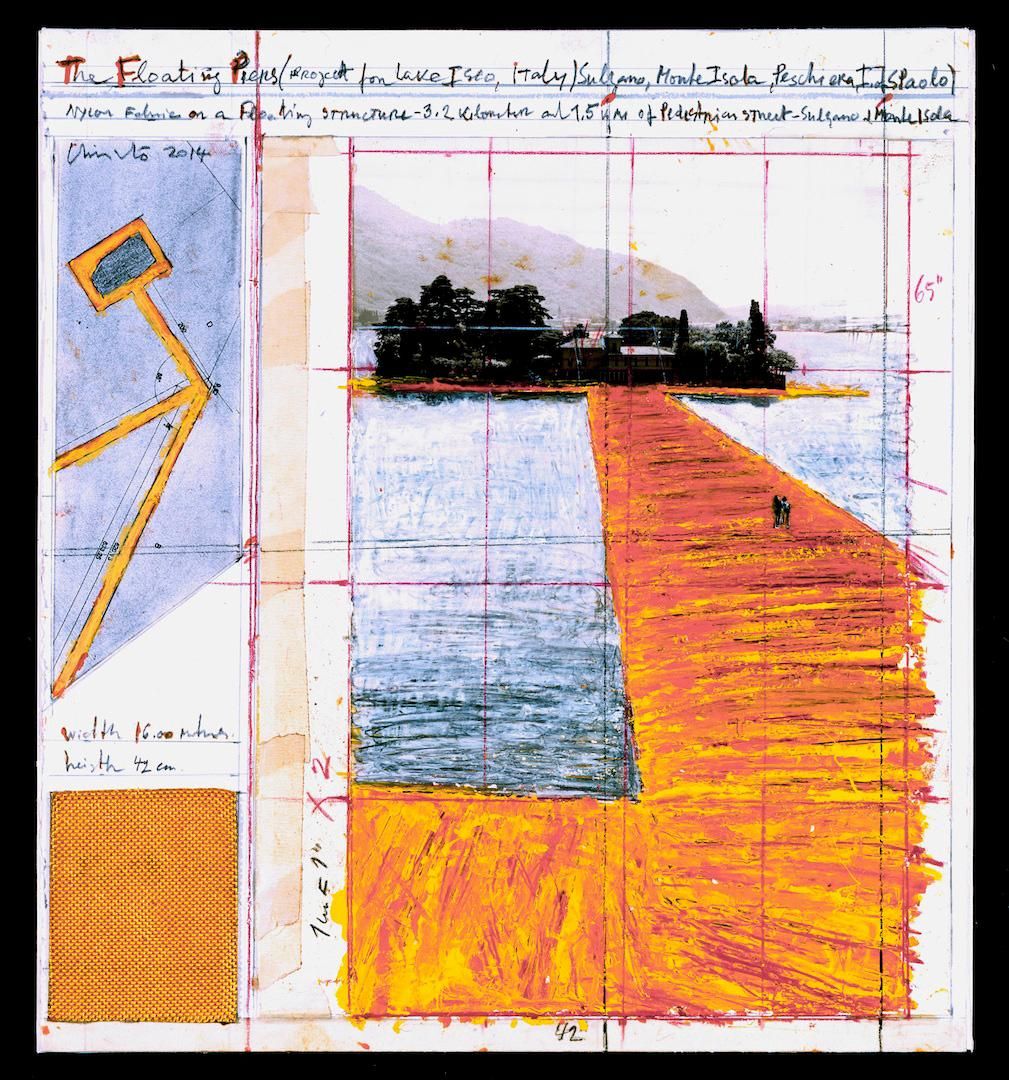
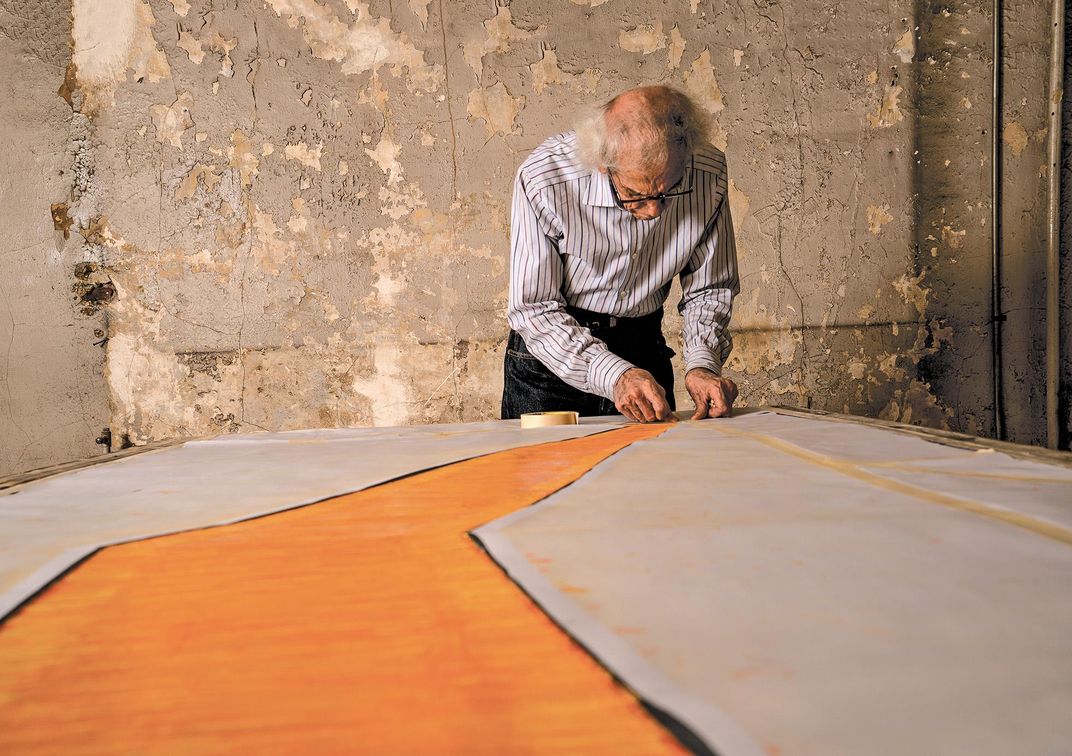
In the months and years leading up to every installation, he produces hundreds of smaller pieces of art: preparatory sketches, studies, models, paintings, collages. This he does solitary. Today the New York studio is filled with scores of canvases in every size and shade of blue; lakes and piers in every medium from pen to pencil to pastel, crayon to paint to charcoal; islands and towers and abbeys mapped equally if by satellite, or sketched in a few quick strokes; uncomplicated as a color cake, or circuitous and precise as an architectural elevation. Some of the multipanel pieces are several meters wide past a meter or more high and sell for hundreds of thousands of dollars to a loyal circle of collectors.
No more will exist produced in one caseThe Floating Piers has come up and gone.
**********
At the shed a few hundred meters up the shore, theFloating Piers team works out of a converted shipping container. The little room is immaculate. Lined with tables and shelves and lockers and computers, stacked with equipment and documents, buzzing with purpose. Three people on three phones having three conversations in three languages. The espresso machine hisses and pops.
There'south Wolfgang Volz, projection manager. He's the smart, mannerly, compact German who's worked on every Christo and Jeanne-Claude project since 1971. Vladimir Yavachev, operations managing director, Christo's nephew—tall, nighttime, funny. Diver and cinematographer, he started his career with Xto and JC more than than twenty years ago—past carrying Wolfgang'southward camera bag. His wife and girl, Izabella and Mina, are hither as well. Working. Frank Seltenheim, assembly director—who got his starting time as ane of the climbers draping cloth over the Reichstag. Antonio Ferrera, documentarian, who records every waking moment of every project. Marcella Maria Ferrari, "Marci," new principal ambassador. "She'southward already one of the states," says Wolfgang, who is also simultaneously on the phone with New York. New York in this case being Jonathan Henery, Jeanne-Claude's nephew and the vice president for all the projects. Slim, mid-40s, he worked shoulder to shoulder with her for 20 years and does now what she did. Organize. Itemize. Energize. Mediate.
**********
The office in New York is an old cast-atomic number 26 building in SoHo. Christo and Jeanne-Claude moved there from Paris in 1964, bought the building from their landlord in the early 1970s and never left. The reception room smells of flowers and honey and patchouli, and there's always music playing depression somewhere. And if you go to visit Christo, he'll come down from the studio to greet you lot, his French cuffs tied with string and covered in charcoal grit, and talk to you lot most anything. Most the old days downtown with Warhol and Jasper and the guys.
"Oh certain," he says, "yes, Andy and Rauschenberg, Johns, in that fourth dimension, we were all trying to make our work visible."
Well-nigh what's next.
"We're waiting now for the federal appeals to tell us aboutOver the River[a long-planned fabric installation on the Arkansas River in Colorado]. It could happen whatsoever moment."
About Jeanne-Claude.
"I miss most the arguments about the piece of work."
And he is not but polite, he is warm and affectionate and engaged, and he never says it, he's too well-mannered, but he wants to get back to piece of work. As soon as you go, as shortly as you shake hands and head for the door, he's on his style back upstairs to the studio.
**********
Ending.
In forepart of all those reporters, Christo said the ropes for the project come up from the USA.
"They come from Cavalieri Corderia," Vlad says. "Up the road in Sale Marasino! V kilometers from here! Where you're speaking tonight!"
"Oyoyoy," says Christo, his comic incantation of surprise or confusion or self-mockery.
"You have to say beginning thing that the ropes forFloating Pierscome from Cavalieri Corderia of Sale Marasino." Vladimir is emphatic.
This is important. Every project uses as many local vendors and fabricators equally possible. Nearly a quarter of a million floating cubes are being blow-molded effectually the clock in four factories in northern Italy, for example. Goodwill and practiced business.
"Oyoyoy. Cavalieri Corderia of Sale Marasino."
Y'all'll hear him whispering it the rest of the day.
The presentation at the community center in Auction Marasino is the same one he gave two weeks ago at a high school in New York Metropolis, but the simultaneous translation slows it down a little.Wrapped Coast. Valley Curtain. Running Fence. Surrounded Islands. Pont Neuf. Reichstag. The Gates.
That Christo speaks in run-on sentences powered past his enthusiasm makes a translator's task harder; she delivers the Italian versionprestissimo—but can never quite catch up.
Get-go thing he says: "I desire to thank the ropemakers of Cavalieri Corderia for all the rope we're using. Excellent." The room erupts in a round of applause.
The small theater is full, peradventure 300 people. This is one of the final stops on the charm campaign. They've done this show in about every village effectually the lake. The audience sees all the projects PowerPointed—fromWrapped Coast toThe Gates in a series of photos, a greatest hits flyover, then a few sketches of The Floating Piers' 220,000 cubes. 70,000 square meters of textile. 160 anchors. Five tons, etc. And so along.
He's out front now, where she used to be.
"The fine art is not just the pier or the color or the material, just is the lake and the mountains. The whole landscape is the work of art. It's all about you lot having a personal relationship with information technology. You in it, experiencing it. Feeling it. I want you to walk across it barefoot. Very sexy."
Translation. Adulation. Then the audition Q and A.
"How much will it cost?" is almost always the first question.
"Zero. It is costless. We pay for everything."
"How do we get tickets?"
"You don't need tickets."
"What fourth dimension does it shut?
"Information technology will be open around-the-clock. Weather condition permitting."
"What happens when information technology's over?"
"We recycle everything."
"How practice you stay and so energetic?"
"I eat for breakfast every 24-hour interval a whole head of garlic, and yogurt."
And Christo always answers ii last questions, even when no 1 asks them.
What is it for? What does it practice?
"It does nothing. It is useless."
And he beams.
**********
Now photographs and autographs with anyone who wants one. And then the mayor takes him up the colina to dinner.
A lovely rustic inn high among the copse. Orazio. In the master dining room, in honor of Christo, an organisation of every local dish and delicacy. Table afterward table of antipasti and meat and fish and breadstuff and wine and vinegar from the fields and farms and streams effectually the lake. A nervous young human rises and makes an earnest spoken language about the unparalleled quality of the organic local olive oil. When he finishes, two cooks carry in a whole roast suckling pig.
At a table in back Christo picks at a small plate of pickled vegetables and roast pork and bread and olive oil while encouraging anybody else to eat up. "Sometimes nosotros take to remind him to eat at all," says Vladimir. Wolfgang is on and off the telephone about the upcoming meeting in Brescia with theprefetto, the prefect, a kind of regional governor. Very powerful.
After dinner, 2 things. Commencement, someone presents him with a "wrapped" bicycle. It is oddly reminiscent of his earliest work; that is, there'southward a wrapped motorcycle of his from the early on 1960s in a collection somewhere worth millions. He's very gracious nigh the bicycle.
So local author Sandro Albini takes Christo'south elbow and spends several minutes explaining his theory that the background of the paintingLa Gioconda (theMona Lisa) is actually Lago d'Iseo. He makes a convincing case. Leonardo visited here. The timing works. Mr. Albini is a serenity sort, simply determined, and the talk goes on awhile.
Giving you the chance to retrieve of Leonardo and art and Christo and how artists work into tardily life and what that might mean. Some artists simplify as they grow quondam, the line becoming gestural, the brush stroke schematic; some complicate, and the work becomes bizarre, rococo, finding or hiding something in a series of elaborations. Some plagiarize themselves. Some give upward.
Matisse, Picasso, Monet, Garcia-Márquez, Blare, Casals. There's no one mode to do it. Maybe information technology's the desire for a perfection of simplicity. "The two urges, for simplicity and experiment, can pull you in reverse directions," says Simon Schama, the art historian. He situates Christo and his projects in a long tradition, a continuum extending from Titian to Rembrandt to Miró to de Kooning. "The essence of information technology is simple, merely the procedure past which information technology is established is a great complication." That's the tension of tardily life essentialism. The elemental language of Hemingway inThe Old Man and the Bounding main. Late Mozart, theRequiem. Beethoven, the chilling clarity of the late Cord Quartets. (So modern they could have been written last week.) Think of Shakespeare, the late plays.The Tempest. Or the Donald Justice verse form, "Terminal Days of Prospero," part of which reads:
(What tempests he had caused, what lightnings
Loosed in the rigging of the earth!)
If at present information technology was all to exercise again,
Zilch was defective to his purpose.
The thought for the piers is more xl years former. Christo and Jeanne-Claude got the notion from a friend in Argentine republic who suggested they brand an environmental piece for the River Plate. Couldn't be done. Then they tried Tokyo Bay, but the hierarchy was incommunicable and the engineering science wasn't in that location. Hence the thought:
"I'm going to be 80 years old. I'd like to do something very hard."
The sometime man is heir to the immature man's dream. The old man honors a hope. Artists do not retire.
Christo cheers Mr. Albini and heads for the machine.
Now dorsum to the shed.
Now to work.
Then to sleep.
**********
Now a field trip. To the acme of the colina behind the mill. The owners know someone who knows someone who owns an estate on the ridgeline a one thousand anxiety up from the shed. Nine people in a Land Rover Defender on a road similar a caprine animal trail drive to the top of the mount.
It's a stately former identify gated and terraced with low walls and gardens and olive trees. The view from every corner is the whole dome of heaven, a world of Alps and lake and sky.
Christo stands solitary at the border of the garden for a long fourth dimension. Looks down to the h2o. Looks down to the sheds. Picturing in the earth what he's already fabricated in his mind. From here he can see it complete.
"Beautiful," he says to no one in item.
Vlad, less moved in the moment by beauty than by opportunity, points at a high summit a few kilometers east and says, "We can put the repeater over at that place." They'll accept their own radio communications network for The Floating Piers. Operations, security, personnel, logistics.
Then Vlad and Wolfi and Antonio are arranging a portrait-sitting for Marci on one of those low walls, using a smartphone to see if the background matches that of theMona Lisa—as was explained to them all at such great length. Marci's smile is indeed enigmatic, but the results are inconclusive.
So.La Gioconda. Think of how it makes yous experience. Think ofThe Gates. Running Fence. The Umbrellas. Wrapped Reichstag. Surrounded Islands. Think of the ability of art.The Gates didn't change Cardinal Park.The Gates didn't change Manhattan.The Gatesinverseyou. Years afterwards you still recall of them.
We reserve for art the same power we grant religion. To transform. Transcend. To comfort. Uplift. Inspire. To create in ourselves a state similar grace.
**********
Now Brescia, and the prefect.
Same presentation, but in a high marble hall to a modest audience of local swells. The prefetto, square-jawed, handsome, humorless in a perfectly tailored blue suit, leads off. Then Christo.
"What I make is useless. Absurd," and then forth, through the years and the projects. He spends a few minutes on two future possibilities.Over the River, andThe Mastaba, a massive architectural undertaking, permanent this time, an Old Kingdom tomb hundreds of feet high congenital of oil drums in the deserts of Abu Dhabi.
When Christo speaks at these things, you get the sense—infrequently simply powerfully—that he'south waiting for Jeanne-Claude to stop his sentence.
Subsequently the PowerPoint the power, and a party for the local gentry in the prefetto's official suite of rooms.
Fancy appetizers, tiny and aggressive, to be eaten standing. Franciacorta in flutes. An entire tabletop of fresh panettone.
For the next 60 minutes Christo stands in place as a stream of local dignitaries present themselves. He shakes hands and leans in to listen to each of them. Antonio floats by with his photographic camera. They'll ask even so questions. When? How much? What side by side?
At that place's e'er a little infinite in the circle for her.
If you spotter him closely enough you can see information technology. Or maybe yous just call back you see information technology. Want to see it. At that place'south a space to his left. And that thing he does with his left paw when he's talking to the politicians and the bureaucrats. How the fingers flex and the pollex brushes the fingertips, like he's reaching for her hand.
**********
At present due west out of Brescia on the autostrada. Christo, Wolfgang, Antonio. Fast. 140, 150, 160 kilometers per hour—the big Mercedes a locomotive in the dark.
Wolfgang driving. Christo deep in the back seat backside him. Antonio up front riding shotgun with the camera in his lap. "I thought that went well," he says. "They were very squeamish. They actually rolled out the cherry carpet for usa."
"They did," says Wolfgang.
Christo is serenity for the first fourth dimension since morning, looking out the window into 60 minutes 15 of a 20-hour day. Italia is a mistiness.
"However..."
"I think they really similar us...really like the project."
"Still," Wolfgang says, "I'd wish for a niggling less red rug and a fiddling more action."
Absently, looking out his window, Christo nods.
"You saw that briefing room," Wolfgang says to Antonio. "We've spent a lot of time in that conference room. Hours. Hours and hours."
"On the permissions?"
"Yes. Nosotros accept all the permits and all the permissions. Now. But it took a lot of meetings around that table. Month after month. Me and Vlad back and forth. Christo. Back and forth. They are very, um,deliberate."
**********
And this is part of the art, too, the private meetings and the public hearings and the proposals and counter proposals and the local politicians nodding and smile. The photo-ops.
"What virtually the traffic plan?" Christo asks. "Could you tell did he read the traffic plan?"
"I don't know," Wolfgang says. "I don't think then."
"Oyoyoy," Christo says low from the far corner of the car.
The traffic program forThe Floating Piers is 175 pages long. Information technology took a year to gear up. It cost €100,000.
"Maybe he'southward read it," Wolfgang says, his hands motionless on the wheel. "Maybe he hasn't. He'due south inscrutable."
Floating Piers will draw perhaps 500,000 visitors in 16 days to a town with i main road.
"Oyoyoy."
"Yes. Indeed. Oyoyoy."
"When volition they read it?"
"Who knows? They are in no bustle."
"We are," says Christo.
"Ever," says Wolfgang.
"It would exist improve to outset sooner."
"Undoubtedly."
"And not get out this for the terminal minute. The buses. The police. The roads. The people. Oyoyoy. How could they non read information technology yet?"
"Perchance he read it. Maybe they all read it."
"Why practise they await? What practise they accept to do? Nothing. Nothing. They only have to agree to it. Merely have to say yeah. They don't fifty-fifty have to pay for anything. We pay for everything."
And then everyone is repose. Italy rushes past. The instrument console glows.
"Still," Antonio says, "they were very prissy."
**********
Maybe this is the life yous'd cull for yourself if you could. Nights all over the globe in strange, wonderful places. You and your family. Loved by anybody.
Now a restaurant in Palazzolo sull'Oglio, a small town a one-half-hr south of the lake.
"Bellissimo grande!" calls a woman on her style out the door equally she sees Christo walking past her. Big beautiful.
Vlad constitute this place. A fourth-generation family unitcucina run by Maurizio and Grazia Rossi. Small. Close to the train station. Dark wood. Frosted glass doors. A workingman's place. On the bar is a Faema Eastward 61 espresso machine every bit large and brilliant every bit the bumper of an antiquarian Cadillac. The dining room in back is hung every which manner with the piece of work of local painters. It's the kind of restaurant you're nostalgic for even every bit yous're sitting in it.
"Relax," Christo says. "Sit down. Eat."
And they do. Frank the climber is here, and Izabella and Mina, and Antonio and Wolfi and Vlad, Marci and Christo, and the sweetness, long-faced president of the lake association, Giuseppe Faccanoni. All at the big table up forepart. Simple carte du jour. Large portions. Tripe soup.Passata di fagioli. White lasagna. Local fish. Local meat. Local wine. The owner'south uncle makes the cheese. Franciacorta from the slopes of Lago d'Iseo. "Salute!"
Conversations and judgement fragments around the table, overlapping dialogue like something out of Preston Sturges. For example, they moved out of a lakeside hotel into a chateau upwardly in the hills.
"We're saving €30,000 a calendar month," says Vladimir. "Mina, honey, what practice you desire?"
"There's a billiard room," Christo says.
"I don't desire the meatballs," says Mina.
"But no one has used it however," says Wolfgang. "I'll have the tripe. Nosotros're all working seven days a week."
"Grazie," says Maurizio.
"Perhaps the meatballs," says Izabella.
Plates come and become, meatballs are eaten, wine poured. Eventually, briefly, the traffic plan comes effectually again.
"Oyoyoy."
**********
Mina is asleep on Izabella'south lap. It's belatedly. Wolfi and Marci are going back and along on their phones with thecarabinieri. An warning went off at the shed, merely no one knows why. Wolfgang thinks the dark watchman tripped it himself.
Dessert now, and Maurizio wants Christo to try the bootleg halvah. "I know what my child likes and I know what Christo likes," Vlad says to him. "He won't like the halvah."
He does not similar the halvah.
So they bring him a big wedge of vanilla cake with fresh whipped cream. For the remainder of the table the owner brings out cookies fabricated by a cooperative of refugee women he sponsors from North Africa. Then espresso. Coming up on midnight.
Vlad takes most of the table dwelling to the chateau. Wolfi drives dorsum to the shed on the lake to piece of work a few hours in the quiet, and to check the alarm.
**********
At dawn it's silent effectually the lake. Nothing moves merely the sun.
Somehow all this exists outside the punch-line postmodernism of kitsch and performance art, outside the smoothen jazz standards of mid-century living room modernism, outside earnestness or irony or intention, exterior category of any kind. Somehow the installations are equally intimate equally they are awe-inspiring, and no matter what else is happening, inside the work of art where you lot stand up you're safe.
The Floating Piers.
Maybe the real work of an artist'south lifeis the artist's life.
**********
A month subsequently he's back in New York City. He works early. He works late. He's upstairs in the studio, making the big pieces to pay for the piers. The French cuffs are night with charcoal.
Vlad calls. Wolfi calls. Marci calls. Calls come up all solar day every day with updates from Italy: more sections finished; more anchors sunk; bills in/checks out; trucks come/trucks go; tourists block traffic to catch a glimpse of the shed; of the piers; of Christo. The prefetto needs more paperwork. The days are tick-ticking abroad.
If you were to visit him, you'd encounter him in that 2d-floor reception expanse. Reporters step in/reporters step out. Christo's tired, just his eyes are bright and the handshake's house.
You'd smell that perfume and hear that music, and by now you'd know the perfume was Jeanne-Claude's. Angel, by Thierry Mugler. Christo sprays it every day, upstairs and down. And the music is the Mozart she loved, the Pianoforte Concerto No. 27, Mozart's last, and he plays it on a loop, low, as the magic to conjure and proceed her.
And then some other dinner downtown.
"Three kilometers," Christo says. "2 hundred xx thousand polyethylene cubes. The Rolls-Royce of cubes. 90 k square meters of textile on the piers and in the streets."
MAYters.
He's edifice the piers out of breadsticks now, laying first the long line from Sulzano to Peschiera Maraglio, and so the angles from Monte Isola to Isola di San Paolo. The footling isle is surrounded by carefully broken breadsticks. The piers are taken upward and eaten when dinner arrives.
A couple of prawns. A bite of salad. One-half a drinking glass of red wine. "Eat," Jonathan says.
"We sold a big one."
"How much?"
"One million two."
"One point two emm?"
"Yes."
Now the wedge of vanilla block. Fresh whipped cream.
**********
Art is not an antidote to loss. Just an answer to information technology. Similar the painting of a adult female past a lake. Like walking on water for two weeks. Years of daredevil applied science and unnecessary effort for something so ephemeral. He'll make some other trip to Italian republic. Then back to New York. Then Abu Dhabi. Then New York. And so Italia. More than shows. More galleries. More museums. Maybe Colorado. Maybe Abu Dhabi. Possibly.
This night he hurries dwelling. He'll work late.
"At that place is a madness of things to be done!"
Such a bright, cursory complication. And artists do not retire.
0 Response to "Art of Person Floating in a Lake Then the Lake Becomes Space"
Post a Comment